I welcome supervision inquiries from motivated students and young researchers at all levels. To ensure I can dedicate the proper time and provide high-quality guidance to every candidate, I am unfortunately not able to accommodate all the requests I receive.
I have several projects currently available, and I also encourage students to propose their own if they are sufficiently close to my research interests. For more information or to schedule a meeting, please get in touch via email.
BSc/MSc. BSc projects typically involve the focused study of a well-defined topic, while MSc theses generally revolve around literature reviews of more advanced subjects and may occasionally develop into original research. In either case, a solid background in mathematical analysis is required, and students should be comfortable using LaTeX and working in English. I provide regular guidance throughout the project, while students are expected to be fairly independent and take responsibility for their project’s progress. Please consider getting in touch sufficiently early before the intended graduation date: in my experience, the whole process typically requires around five months for a BSc project and around nine months for an MSc thesis.
PhD. Prospective PhD students are welcome to contact me to discuss research interests and potential supervision. Please note, however, that admissions to the PhD programs at Politecnico di Torino take place through public competitions and are handled at the department level by appointed committees.
External students. While my thesis proposals are primarily intended for students in mathematics- and physics-oriented degree programs at Politecnico di Torino, I am happy to consider cosupervising students from other universities and/or different degree programs when our scientific interests align.
Topics
Here is an informal overview of my research areas, which can serve as starting point for further reading and exploring possible thesis topics – follow the links!
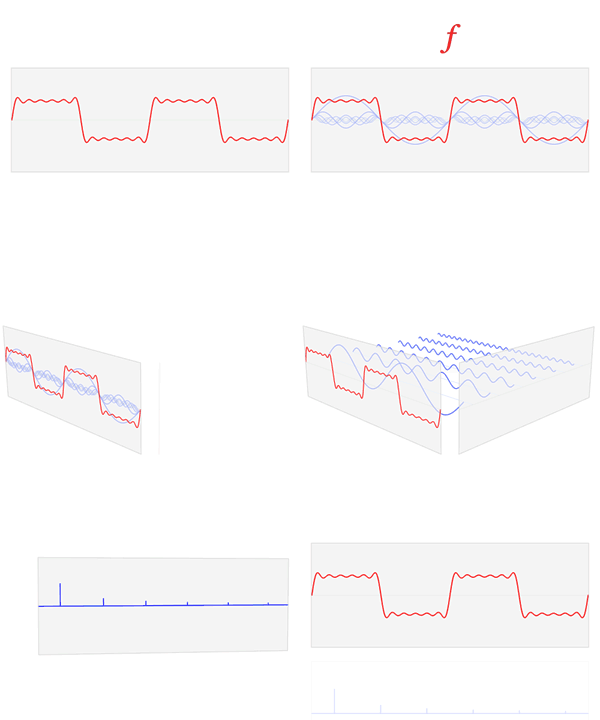
In 2022 we celebrated the bicentennial of the publication of Fourier’s Théorie analytique de la chaleur. In this seminal work he solved the heat equation by leveraging the visionary idea that any function can be viewed as the superposition of sinusoids. Modern Fourier analysis continues to build upon this insight, but nowadays sinusoids are replaced by different dictionaries of elementary signals.
The ultimate goal is to perform a joint time-frequency analysis of a function/distribution. However, it turns out that time and frequency have a dual nature – two faces of the same coin, and trying to keep an eye on both faces at the same time is hampered by the diverse manifestations of the uncertainty principle.
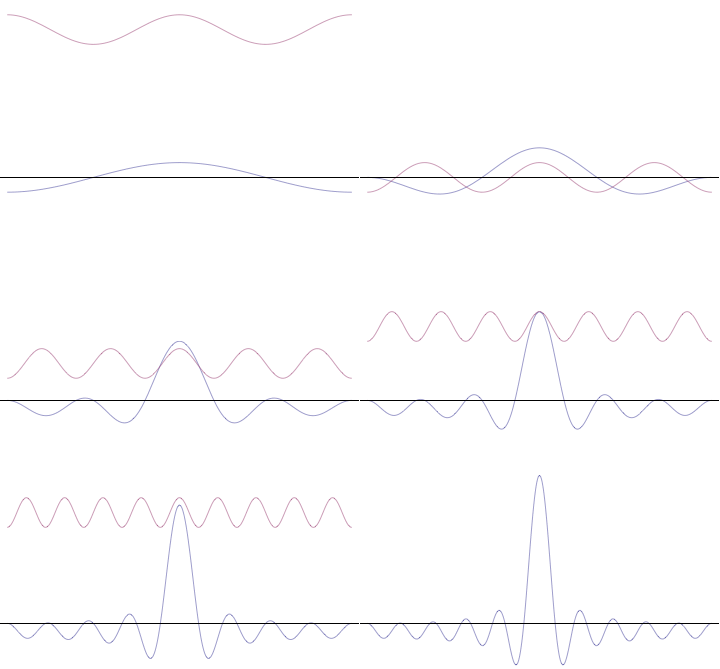
This research area naturally interlaces several branches of modern analysis. Some aspects I am interested in:
Time-frequency and multiscale analysis. We decompose functions and distributions into elementary wave packets in terms of Gabor atoms, wavelets, shearlets, etc. In short, this is the mathematical theory of signal processing, and also provides a powerful approach to study the key features of more general operators and PDEs.
Microlocal and semiclassical analysis. In a nutshell, they provide a rigorous framework for understanding the high-frequency behavior and the short-wavelength limits of oscillatory models. Tools like wave front sets are introduced to detect the location and nature of singularities in solutions to PDEs.
Function spaces of harmonic analysis. In order to deal with time and frequency/scale jointly, several ad hoc function spaces are introduced – such as Sobolev, Besov, modulation and amalgam spaces. Understanding the properties of these spaces is crucial for many purposes, including well-posedness of PDEs or discrete approximation algorithms.

Localization in phase space and uncertainty principles. Informally, the uncertainty principle is a metatheorem that states that a signal cannot be perfectly localized in both time and frequency. We explore in a quantitative way the many facets of this issue, as it poses significant challenges in signal processing and quantum mechanics.

We investigate problems of quantum theory through a rigorous mathematical lens, using a wide array of techniques from functional analysis, spectral theory and operator algebras. This approach is closely related to phase space analysis, since several pairs of physical quantities (like position and momentum) share a dual nature similar to that of time and frequency.
Here are some topics I am particularly interested in.
Quantization and pseudodifferential calculus. This area explores the relationship between classical and quantum observables, in order to make a rigorous transition from the commutative world of functions on phase space to the non-commutative realm of operators in quantum mechanics, using different quantization rules and related calculi.
Operators and PDEs in mathematical physics. We study the properties of solutions to key equations in QM such as the Schrödinger, Dirac, and Klein-Gordon equations. We also analyze the regularity and time evolution of these solutions, as well as distinctive phenomena and the spectral properties of their associated quantum Hamiltonians.
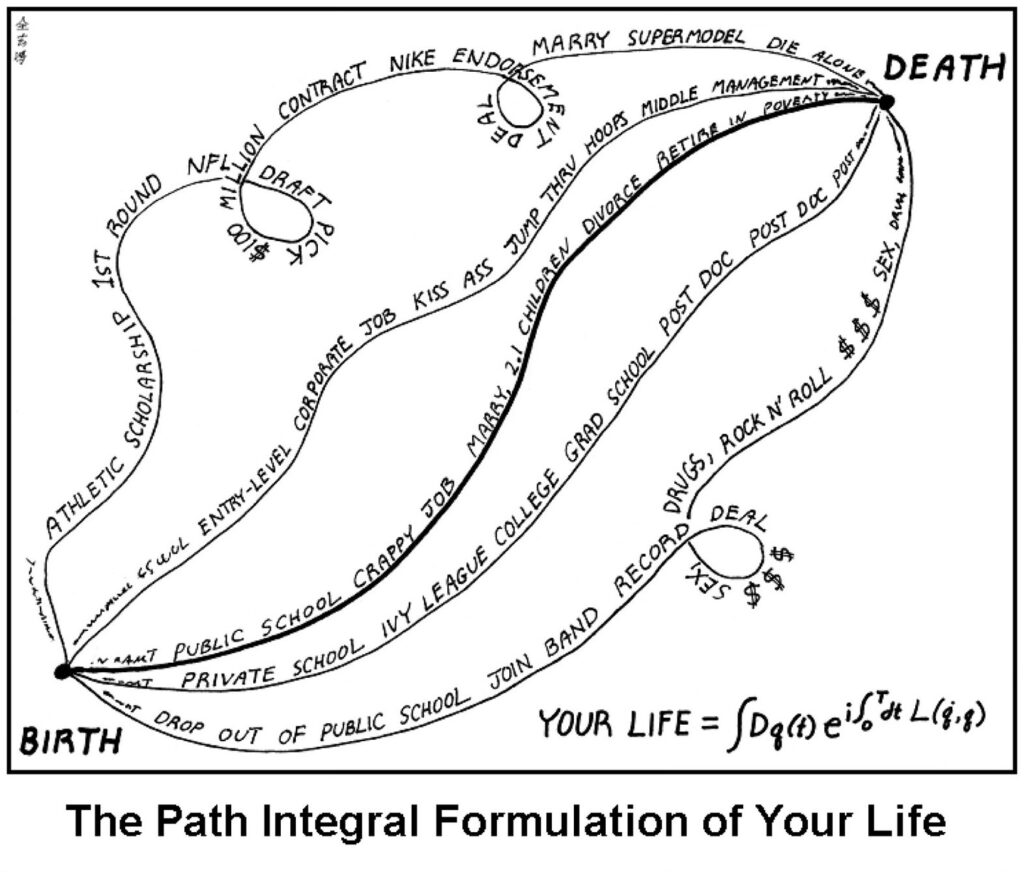
Rigorous Feynman path integrals. This involves making Feynman’s (very effective!) heuristics of quantum dynamics – that a system’s behavior arises from a weighted virtual exploration of all its possible histories – mathematically sound, which still remains a largely open challenge.
Quantum information. As quantum computing becomes more tangible, there is a growing need for a rigorous understanding of information theory. We explore mathematical results related to concepts like entanglement, quantum channels and entropy.
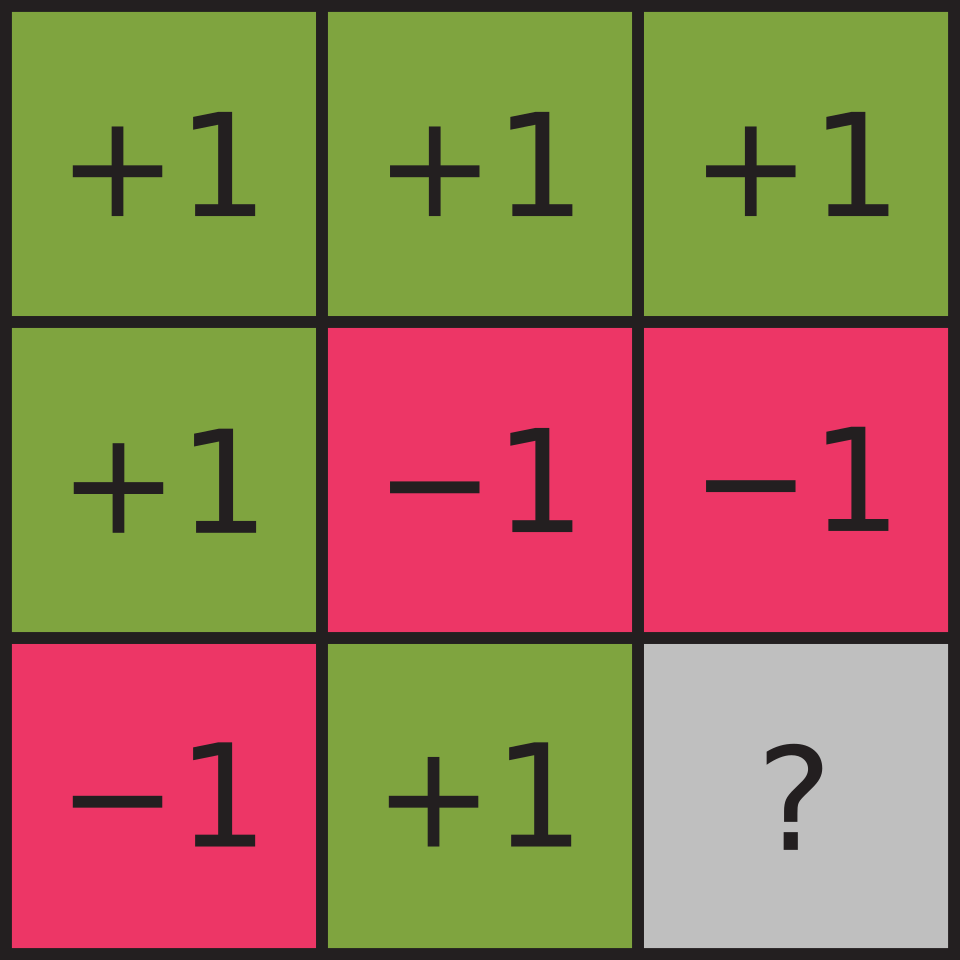
This dynamic field entails leveraging theoretical principles from harmonic analysis to design powerful approaches for tackling real-world challenges in data science and signal processing. Different types of signals, from sounds to images, are variously represented using tools of approximation theory such as expansions with respect to bases and frames.
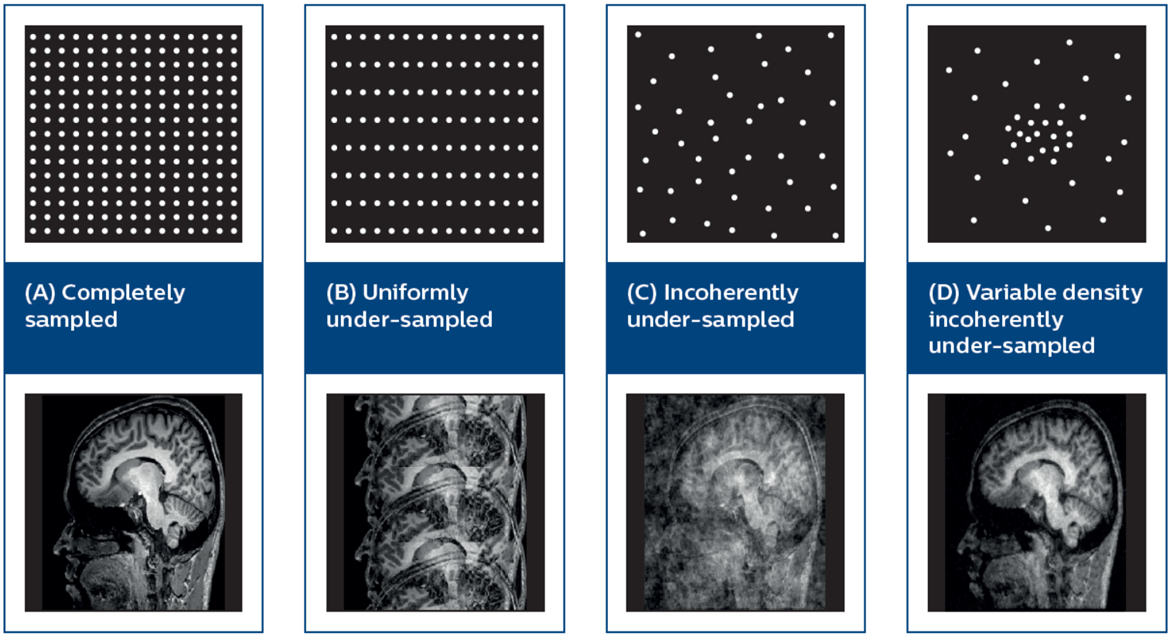
A key concept is sparsity, which refers to representations with a limited number of significant coefficients. This is the main thrust of compressive sensing, which allows for accurate reconstruction of signals and images from surprisingly few measurements, and has already had a significant impact on diverse fields like medical imaging, non-destructive testing and astronomy.
More generally, we address inverse problems in imaging and PDEs, where the goal is to accurately recover a quantity of interest from indirect, noisy measurements. We use mathematical tools to design and ensure robustness and efficiency of reconstruction procedures.

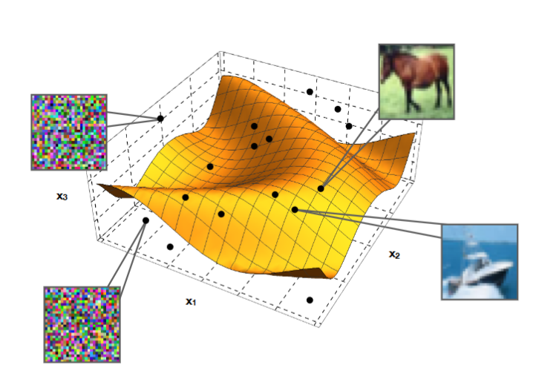
Recent applications of harmonic analysis ideas can be found in the mathematics of data science. Specifically, the analysis of deep learning models like convolutional neural networks, the geometry of data manifolds, geometric learning on non-Euclidean domains (e.g., graphs) and in high-dimensional spaces are challenges that can greatly benefit from the powerful lens of Fourier analysis.
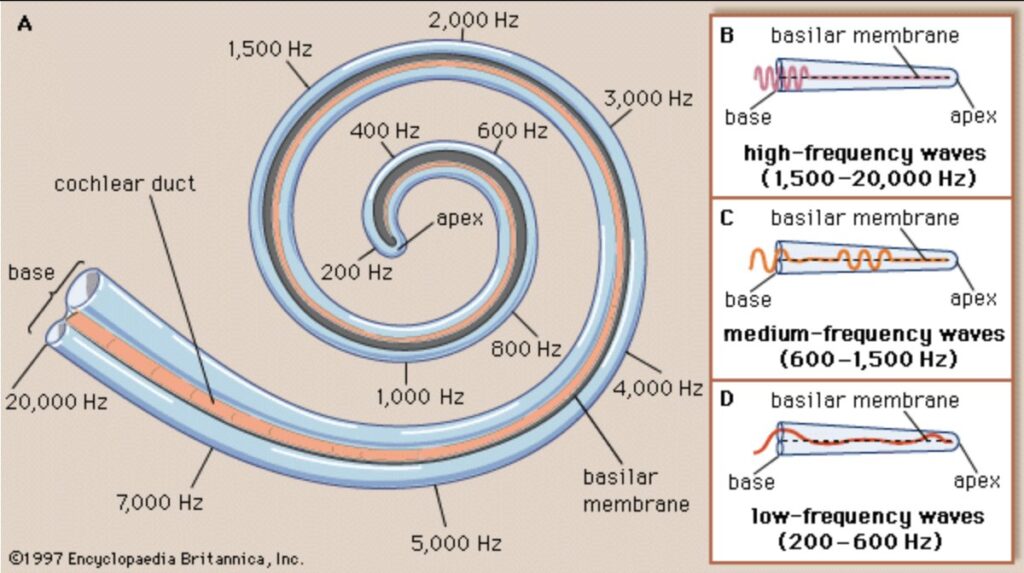
To conclude, we mention that multiscale analysis is the mathematical language of perception, providing tools and models for the neurophysiology of vision and hearing. Indeed, wavelet filters help us understand how the visual cortex breaks down images into basic features like edges. Moreover, it turns out that our auditory system inherently performs multiresolution analysis.
Supervised projects
(2026) Gabriele Gentile
PoliTO, Mathematical Engineering (LM-44) – UROP@PoliTO
Metaplectic Mixing in Wigdersons’ Uncertainty Principles
(2026) Anna Kiema
University of Nairobi (Erasmus+ @PoliTO), MSc Pure Mathematics
Recent Advances in Approximation of Operator Semigroups
(2025) Eugenio Del Nero
Università degli Studi di Torino, Mathematics (LM-40)
Expressivity of Neural Networks
(2024) Claudio Fantasia
PoliTO, Data Science and Engineering (LM-32)
Patch-based Learning of Space-variant Hyperparameters in Variational Image Restoration
(2024) Vitória Dos Anjos
Università degli Studi di Torino, Mathematics (LM-40)
Aspects of Geometric Learning with Convolutional Neural Networks
(2023) Cristina Febbraiola
PoliTO, Mathematical Engineering (LM-44)
Time-Frequency Analysis and Localization Operators
(2024) Alessandro Falcone – PoliTO, Mathematics for Engineering (L-35)
Topics: the Radon transform and applications
(2024) Giorgia Malfeo – PoliTO, Mathematics for Engineering (L-35)
Topics: basics of quantum dynamics and the Schrödinger equation
(2024) Alberto Spinello – PoliTO, Mathematics for Engineering (L-35)
Topics: aspects of high-dimensional Euclidean spaces
(2023) Valerio Taralli – PoliTO, Mathematics for Engineering (L-35)
Topics: mathematical structure of convolutional neural networks
(2023) Alessandro Di Grazia – PoliTO, Mathematics for Engineering (L-35)
Topics: uncertainty principles in quantum mechanics and Fourier analysis